AI foundations
From handwoven fans to a pavilion: craft and collaborative learning in Bamako
At Kabakoo, 16 learners transformed about 2,000 handwoven fans into an experimental pavilion, bringing Sahelian craft into a contemporary building project supported by human mentorship and a technology-enabled learning framework.
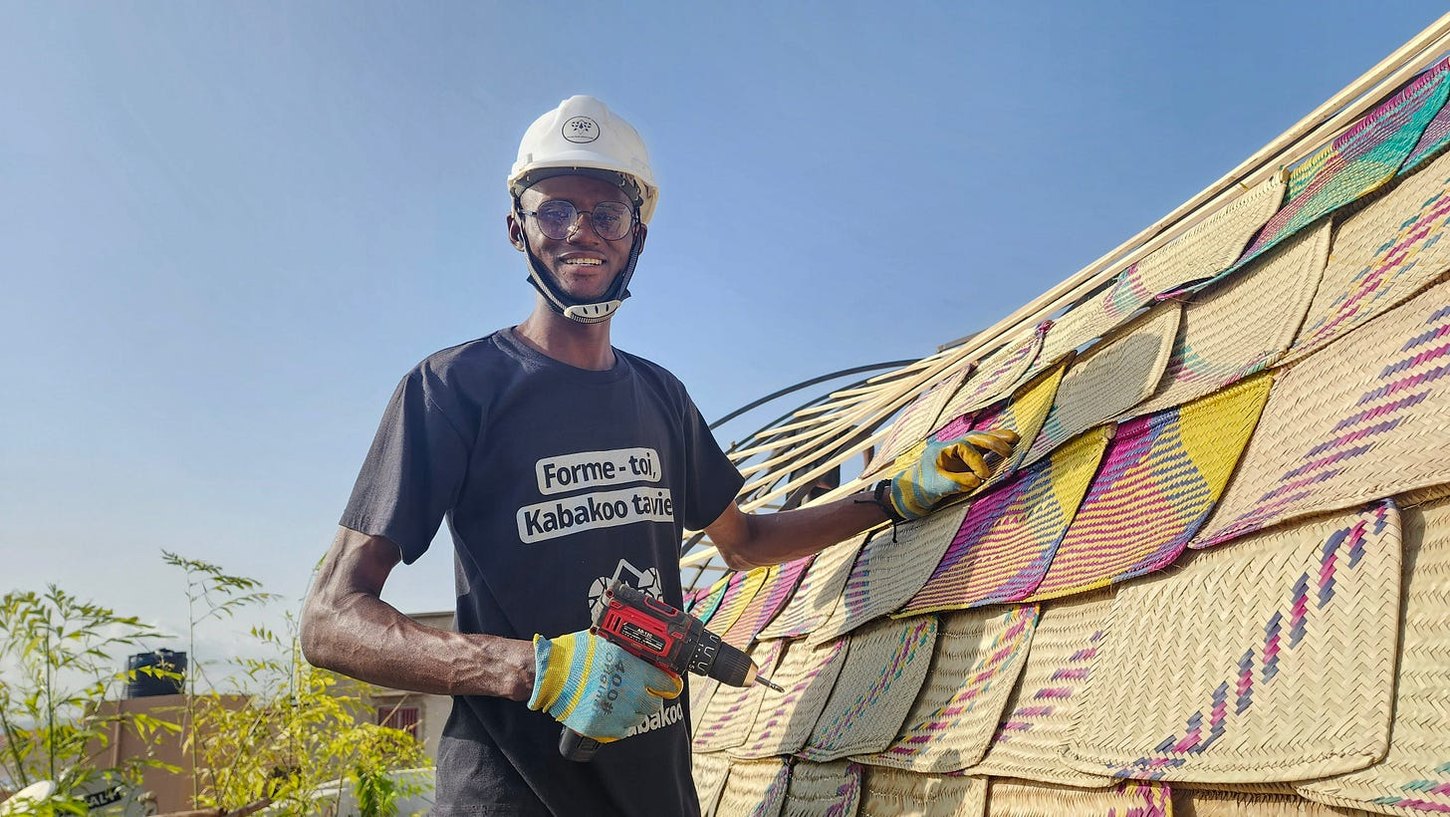
At Kabakoo, everyday Sahelian hand-fans became the building material for Le Nid de Bamako. Over six intense weeks, 16 learners transformed about 2,000 handwoven fans into a 130 m² experimental pavilion: a contemporary structure made with a familiar, handmade object.
1. Begin with local materials and weaving traditions
The brief, ‘Construire son nid’, came from Season #3 of Bamako.AI, on the topic ‘Artificial Intelligences & Radical Care’. It invited learners to design and build a modular nest using local materials and Sahel weaving traditions. The 16 learners, whose backgrounds included IT, photography, and logistics, worked in four teams on the collective task of designing and building a functional structure.
2. Bring craft knowledge into the residency
Samaou Touré, a master weaver from Gao in her 60s, left her hometown for the first time to join the Kabakoo residency in Bamako, bringing a deep connection to wickerwork’s origins. Designer Cheick Diallo described a process that deliberately left room for learners’ ideas: he avoided imposing a design and instead sought debate. Mamadou Koné connected the pavilion to architectural principles shared with restoring Timbuktu’s mosques, including how a structure breathes, responds to sunlight, and gathers people.
3. Turn fifalan into a building system
The design used fifalan, everyday Sahelian hand-fans that are affordable, 100% handmade, and replaceable. Rather than weaving the pavilion’s surface in place, the team mounted the fans like scaled shingles on a steel skeleton. The finished ovoid structure measures 11 meters long by 7 meters wide, rises over 3 meters, and has a 3-meter-wide entrance opening.
4. Support hands-on projects with a shared learning framework
Kabakoo places such projects within a challenge-based, mentored cohort framework. Its technology backbone gives learners access to foundational modules through a mobile app, 24/7 support from an AI Mentor, and collaboration tools such as WhatsApp. The framework also applies to projects including a no-code app for an agribusiness, digital marketing for artisans, and hardware for farmers. Explore related work in Kabakoo’s project updates.